What Is Holding Anthropic and OpenAI Back From Taking Over the World?
What Is Holding Anthropic and OpenAI Back From Taking Over the World?
By Elliot | Ellina Management & Investments LLC | May 2026
There is a moment in every transformational technology cycle where the people paying close attention can see what's coming, and the people not paying close attention think the believers are delusional. We are in that moment right now with artificial intelligence.
I've spent weeks thinking through what the growth of Anthropic and OpenAI actually means, not just for the technology industry, but for capital markets, for business operations, and for how we think about deploying capital at Ellina. What follows is where I've landed.
THE NUMBERS ARE NOT NORMAL
The revenue growth Anthropic and OpenAI have produced over the past 18 months is unprecedented in the history of capital markets. Not fast. Not impressive. Unprecedented. No company at this scale has compounded at this rate. Ever.
The natural question is whether it continues. And the natural instinct, shaped by decades of boom-bust cycles, is to look for the bubble. I've looked. Here is what I found.
The constraint on these companies' growth is not demand. Every enterprise on the planet wants more of what they're building. The constraint is not talent. The constraint is not product-market fit. The constraint is physics.
Anthropic and OpenAI need data centers, compute, and electrical power at a scale the world has never built before. If those resources were unconstrained today, both companies would look unrecognizable six to twelve months from now. The question of whether their valuations are justified is really a question of how fast the physical infrastructure can be built to support what their software is already capable of doing.
When you ask the question that way, the answer changes. These companies are not overvalued. They are supply-constrained.
THE INFRASTRUCTURE IS THE INVESTMENT
This framing led me to a more useful question for Ellina: where does the investable opportunity actually sit?
The frontier labs themselves are largely private, and access is gated. But the infrastructure those labs cannot exist without is not. The data centers, the compute, the power sources. These are real assets. They win regardless of which frontier model wins the race. And they are the binding constraint on everything above them.
The framework I kept returning to: picks and shovels beat gold miners in the gold rush. The miners who struck it rich were the exception. The people selling the equipment got paid regardless.
That said, the picks-and-shovels framing only takes you so far. The more interesting question is whether any single entity is positioned to own all three layers of the infrastructure stack: compute, power, and data centers. And whether owning that entity is the right bet rather than spreading capital across three separate plays.
SPACEX IS A CATEGORY OF ONE
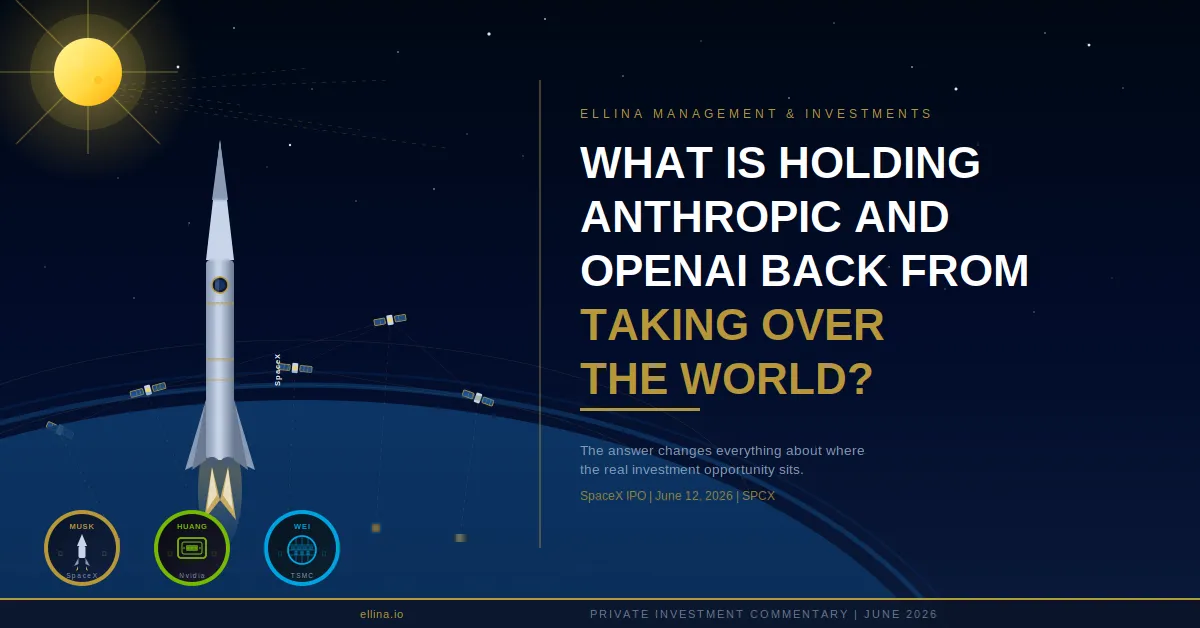
Nvidia owns compute. But Nvidia doesn't own power, and it doesn't own data centers. TSMC owns the wafer manufacturing that makes Nvidia's chips possible, and TSMC is arguably the single most important chokepoint in the entire AI buildout. But TSMC is a single-geography, geopolitically exposed bet.
The company that has a legitimate claim to owning all three layers is SpaceX.
SpaceX's xAI merger, completed in February 2026, created something that has no comparable entity in public markets. Colossus 1 in Memphis is already operating at 220,000 Nvidia GPUs and 300 megawatts of power, with Anthropic signed to its full capacity at $1.25 billion per month through 2029. That contract carries a disclosure worth noting: either party may terminate with 90 days notice, a provision reported by The Information and confirmed in the S-1. For a long-term investor, that clause is a risk to monitor, not a reason to walk away. The contract represents roughly $40 billion in total committed value, and Anthropic's dependency on Colossus compute for training its next Claude model makes termination a mutual destruction scenario, not a unilateral exit. Colossus 2 is coming online. The Cursor acquisition closes within 30 days of the IPO. And the long-term orbital compute vision, data centers in space powered by continuous sunlight with no cooling overhead, is not science fiction. It is an engineering roadmap with a company that has already proven it can build things no one else can build.
Starlink adds a layer that no other AI infrastructure company has: a profitable, cash-generating business funding the buildout. Starlink produced $11.4 billion in revenue and $4.42 billion in operating income in 2025. It has 10 million subscribers across 160 countries. The closest competitor, Amazon Leo, has approximately 300 satellites in orbit. Starlink has over 10,000. That gap does not close in three years. It may not close in ten.
The remaining growth constraints on Starlink are real but solvable. Terminal costs dissolve when Starlink goes direct-to-cell, reaching the majority of the world that already carries a smartphone but has no reliable broadband. The regulatory fight, country by country, is the same fight Uber fought and largely won, the same fight Tesla's Full Self-Driving is fighting now. Technology tends to win these battles. It is slow and attritious, but the direction is clear.
THE TESLA QUESTION
The Bloomberg reports of a potential SpaceX-Tesla merger are out there, and any Tesla shareholder who is paying attention has to think through what that means before deciding whether to rotate into SpaceX at IPO.
If a merger happens, what matters is not which ticker you hold going in. What matters is the exchange ratio. If the deal is struck at fair value, a Tesla shareholder and a SpaceX shareholder end up in the same place. Selling Tesla to buy SpaceX at IPO premium, and then watching a merger get announced at a ratio that reflects SpaceX's elevated post-IPO valuation, is not a better outcome than simply holding Tesla and letting the merger come to you.
The smarter play, if you believe the merger happens, is to wait. Watch the terms. Then decide.
But there is a more interesting argument underneath this one. SpaceX and Tesla are not redundant bets. Tesla is the energy storage, autonomous vehicles, and robotics layer. SpaceX is the orbital infrastructure, satellite broadband, and AI compute layer. If they merge, what you get is a single entity with the most complete vertical stack in the history of technology: energy generation and storage, autonomous ground transport, humanoid robotics, AI compute infrastructure, satellite broadband, and orbital data centers. That is not a conglomerate. That is a civilization-scale operating system.
For a long-term holder, the merger risk is not that Tesla shareholders lose. It is that the combined entity becomes so large and so complex that the market takes years to properly price it. That is the same risk it took to hold Tesla through 2019 and 2020 before the market caught up to what the company was actually building.
Existing Tesla shareholders should not panic-sell into SpaceX at IPO. They should size a SpaceX position independently, on its own merits, and hold both. If the merger comes, the terms will tell you what to do next.
THIS IS NOT FOR THE FAINT OF HEART
The AI buildout is the most important investment cycle of our lifetime. SpaceX, going public June 12 under ticker SPCX on Nasdaq, is the closest thing to a pure-play on the infrastructure layer that will support everything built above it. Elon Musk's 85% voting control, unusual by any conventional governance standard, is a feature for a company trying to build markets that don't yet exist. Nothing extraordinary was ever built by consensus or committee.
What remains unknown: whether the stock drops 40% in the first 90 days after IPO. History says it might. Mega-listings at this scale frequently retrace sharply before they find their footing with public markets. That is painful in the moment and irrelevant to a 10-year thesis.
Tesla required that same kind of conviction through years when the skeptics were loud and the believers were few. The same will be true of SpaceX. Jensen Huang has said his goal is to create markets where none exist. That is exactly what Elon Musk is doing in space. The market SpaceX is building, orbital compute, satellite broadband for the entire planet, AI infrastructure as a service at scale, does not have a ceiling anyone can identify.
THE POSITIONING
Nvidia owns the compute layer but is supply-constrained by TSMC's deliberate production discipline. TSMC's conservatism is, as investor Gavin Baker has argued, the thing most likely to prevent this AI cycle from collapsing into a dot-com style bubble. That discipline protects the ecosystem even as it caps near-term upside for Nvidia holders.
The question still being worked through: does Ellina need direct exposure to TSMC, the unsung chokepoint of the entire AI stack? And does the Constellation Energy angle, power as the other binding constraint, deserve a position alongside SpaceX?
These are the next questions. The thesis underneath them is settled.
The AI buildout is real. The infrastructure is the investable opportunity. SpaceX is the only company building a moat in a market that doesn't yet exist, funded by proven businesses that are already generating billions in operating income. The valuation will feel uncomfortable the day it lists. So did Tesla's in 2010.
We intend to hold for an abnormally long time.
Elliot is the CEO of Ellina Management & Investments LLC, a private equity firm focused on growth equity, corporate development, and strategic planning in technology, AI, and renewable energy. The views expressed here are his own and do not constitute investment advice.
SOURCES
1. SpaceX S-1 Registration Statement, filed with the SEC on May 20, 2026. Primary source for all SpaceX financial figures including 2025 consolidated revenue ($18.67B), Starlink revenue ($11.4B) and operating income ($4.42B), net loss ($4.94B), Musk voting control (85.1%), and IPO structure.
https://www.sec.gov/cgi-bin/browse-edgar?action=getcompany&company=space+exploration+technologies
2. "SpaceX Files for the Largest IPO Ever While Absorbing a $4.94 Billion Loss From Its xAI Merger," TechTimes, May 2026. Covers S-1 financial disclosure including Starlink subscriber count (10 million across 160 countries), launch revenue ($4.1B), and xAI segment operating dynamics.
3. "SpaceX IPO Guide: S-1 Breakdown, Valuation & Trading Strategy," BitMEX, May 2026. Source for xAI merger announcement (February 2026, $1.25T combined valuation), Anthropic/Colossus contract terms ($1.25B/month through May 2029), IPO target valuation range ($1.75T-$2T), and retail investor allocation (30% of float).
https://www.bitmex.com/blog/spacex-ipo-guide
4. "SpaceX SPCX IPO S-1 Full Teardown," The VC Corner, May 2026. Source for Musk dual-class share structure details (Class A/B), 85.1% voting control, Colossus I/II compute agreement with Anthropic, 90-day termination clause (confirmed in S-1), and controlled company governance opt-out.
https://www.thevccorner.com/p/spacex-spcx-ipo-s1-teardown-valuation-2026
5. "SpaceX Acquires xAI: Rockets, Starlink, and AI Under One Roof," Futurum Group, February 3, 2026. Source for xAI/SpaceX merger structure, combined $1.25T valuation, xAI pre-merger valuation ($230B), and Amazon Leo FCC satellite deadline context.
https://futurumgroup.com/insights/spacex-acquires-xai-rockets-starlink-and-ai-under-one-roof/
6. "How Many Amazon Kuiper (Leo) Satellites Are in Orbit?," Orbital Radar, 2026. Source for Amazon Leo current satellite count (300+ production satellites), Starlink active satellite count (10,336+), and FCC deployment deadline status.
https://orbitalradar.com/how-many-kuiper-satellites
7. "Amazon Seeks FCC Extension of Satellite Deadline, Lacks Rockets," Bloomberg, January 30, 2026. Source for Amazon Leo's request for a 24-month FCC deadline extension to July 2028, citing rocket shortages.
8. "The Trillion-Dollar IPO Test: SpaceX and OpenAI Face Public Markets," Investing.com, May 2026. Source for xAI segment operating loss ($2.47B in Q1 2026), Starlink subscriber growth projections, and Pentagon NSSL Phase 3 contract ($5.9B).
9. "Watts, Wafers, and the Future of AI Infrastructure," Invest Like the Best with Patrick O'Shaughnessy, featuring Gavin Baker, May 20, 2026. Primary source for the infrastructure investment framework: compute (wafers), power (watts), and data centers as the binding constraints on AI growth; TSMC supply discipline as the stabilizing force in the AI buildout cycle.
