The Mute button
There is a number that quietly governs the whole world. It is the interest rate on long-term U.S. government debt. Right now, two of the smartest people in finance are fighting over it. One wants to turn the alarm off. The other says that is the most dangerous thing you can do.
Here is the fight, and why it matters to anyone who holds dollars.
First, one idea you need
When the government spends more than it collects in taxes, it borrows the difference. It borrows by selling bonds. A bond is just an IOU. You hand the government money today, and it promises to pay you back later, with interest.
The interest rate on that bond is called the yield. And here is the one thing worth slowing down for: when investors get nervous about lending, they demand a higher yield to take the risk. So a rising yield is a warning light. It is the market saying, out loud, “we are worried about this debt.”
That light has been getting brighter. This summer the government had to offer the highest yield on 30-year debt since 2001 just to find buyers. Investors were nervous. And they had a reason to be. The national debt is around 40 trillion dollars and climbing.
What the Treasury did
Scott Bessent runs the Treasury. He did not like what that warning light was saying. So he reached for a tool called a buyback. The government went into the market and started buying back its own bonds.
Buying pushes prices up. And when bond prices go up, yields go down. So by becoming a buyer, the Treasury was trying to push the warning light back down. It announced it would double the size of these purchases. Then it hinted it might spend even more.
Think about what that really is. It is a business that makes a product, sells it, and then quietly buys it all back to convince everyone the product is popular. The demand is fake. And faking demand is not a plan. It is a stall.
Enter the mentor
The loudest objection came from Stanley Druckenmiller. He is a legendary investor. He is also the man who trained Bessent decades ago. So this is a teacher telling his former student he has forgotten the first lesson.
Druckenmiller’s point is simple. The yield is not noise. It is information. It is the one signal that forces a government to behave, because it makes reckless spending expensive. He calls it the only fiscal disciplinarian the country has left.
His best line says it all. If the 30-year bond has to pay 5.5 percent to find buyers, that is not a crisis. It is an invoice. The bill is real. Hiding it does not make it disappear. It just means you stop looking at what you owe.
Why quieting the alarm is the dangerous part
Here is the heart of it, and it is worth reading twice.
Nothing the Treasury is doing cures the problem. It only quiets the alarm and hopes the problem fixes itself.
The buyback happens in the bond market. But the real fix, if it comes, has to come from the actual economy growing. Those are two different rooms. Pushing the yield down does nothing to make the country richer. It just turns off the smoke detector while you wait to see if the fire goes out on its own.
And there is a trap inside the stall. The Treasury does not have unlimited money. It has a cash account and the ability to borrow more, and that is it. The Federal Reserve can print money forever. The Treasury cannot. So the moment traders realize the Treasury is defending a price with a limited wallet, they push against it to see how fast the wallet empties. As Druckenmiller puts it, governments that fight the market always lose. The only question is how much they burn before they admit it.
So what is Bessent actually betting on?
This is the part most coverage misses. Bessent is not stupid. He has a bet. He is betting that artificial intelligence will make the economy grow so fast that the country simply grows its way out of the debt.
It is a real possibility. If the economy booms, the debt shrinks compared to the size of everything, and the problem eases without anyone having to make hard choices. That is the one escape door that does not hurt.
But look closely at the numbers. To grow out of this debt through growth alone, the economy would need to expand at more than 4 percent every year for a decade. Its most recent quarter came in at just 1.5 percent, and it has been running below 2 percent. It has almost never held a pace above 4 percent for that long. So the bet is not small. It is enormous.
And here is the quiet tell. If Bessent were truly sure the growth was coming, he would not need to touch the bond market at all. Real growth lowers yields honestly, on its own. You only reach for the mute button if you are worried the patient might panic before the medicine kicks in. The suppression is not confidence. It is a confession of doubt wearing a confident face.
That is why the market shrugged. The day Bessent announced the buyback, yields dipped for an afternoon. By the next day they had climbed right back. The market did not see strength. It saw nervousness in a nice suit.
One picture of the whole fight
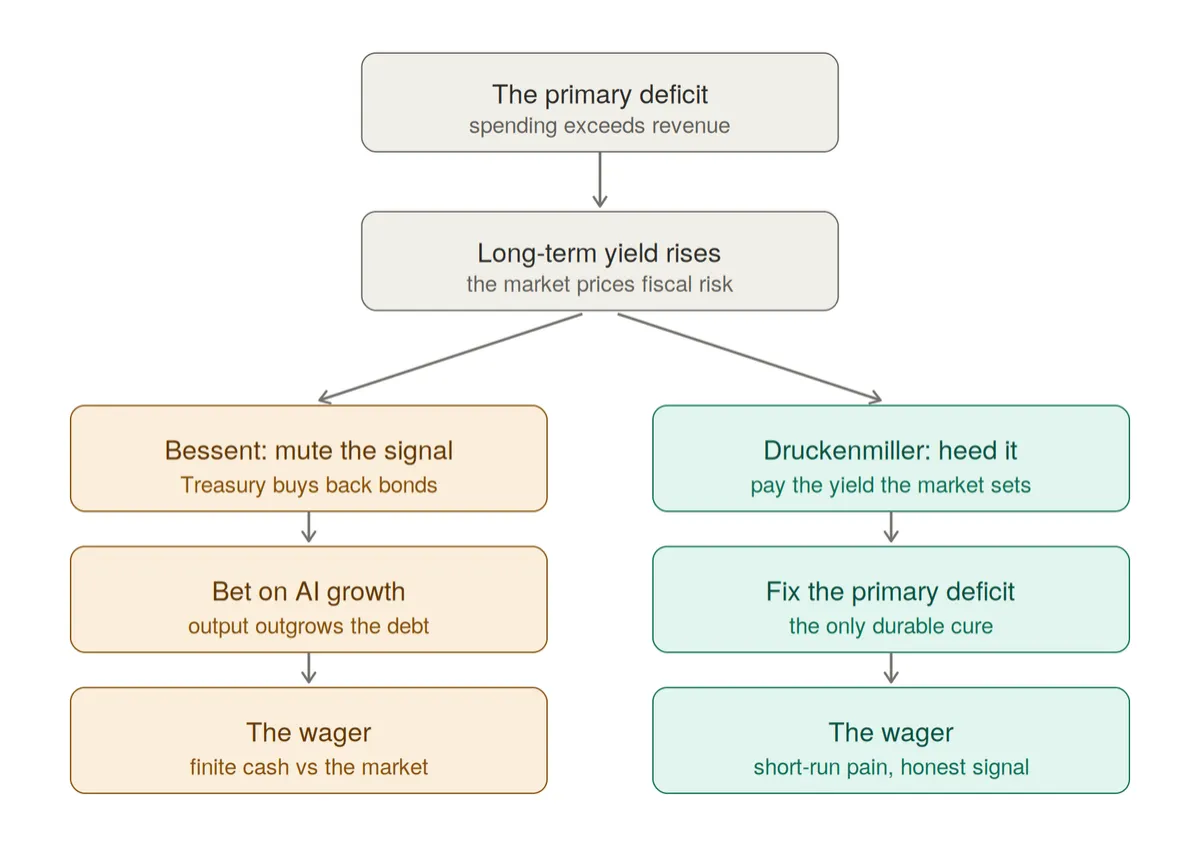
Here is the entire argument on one page. The deficit at the top is the disease. The rising yield beneath it is the alarm. Then the path splits. Notice that every box on Bessent’s side routes around the deficit. Only Druckenmiller’s side connects back to it.
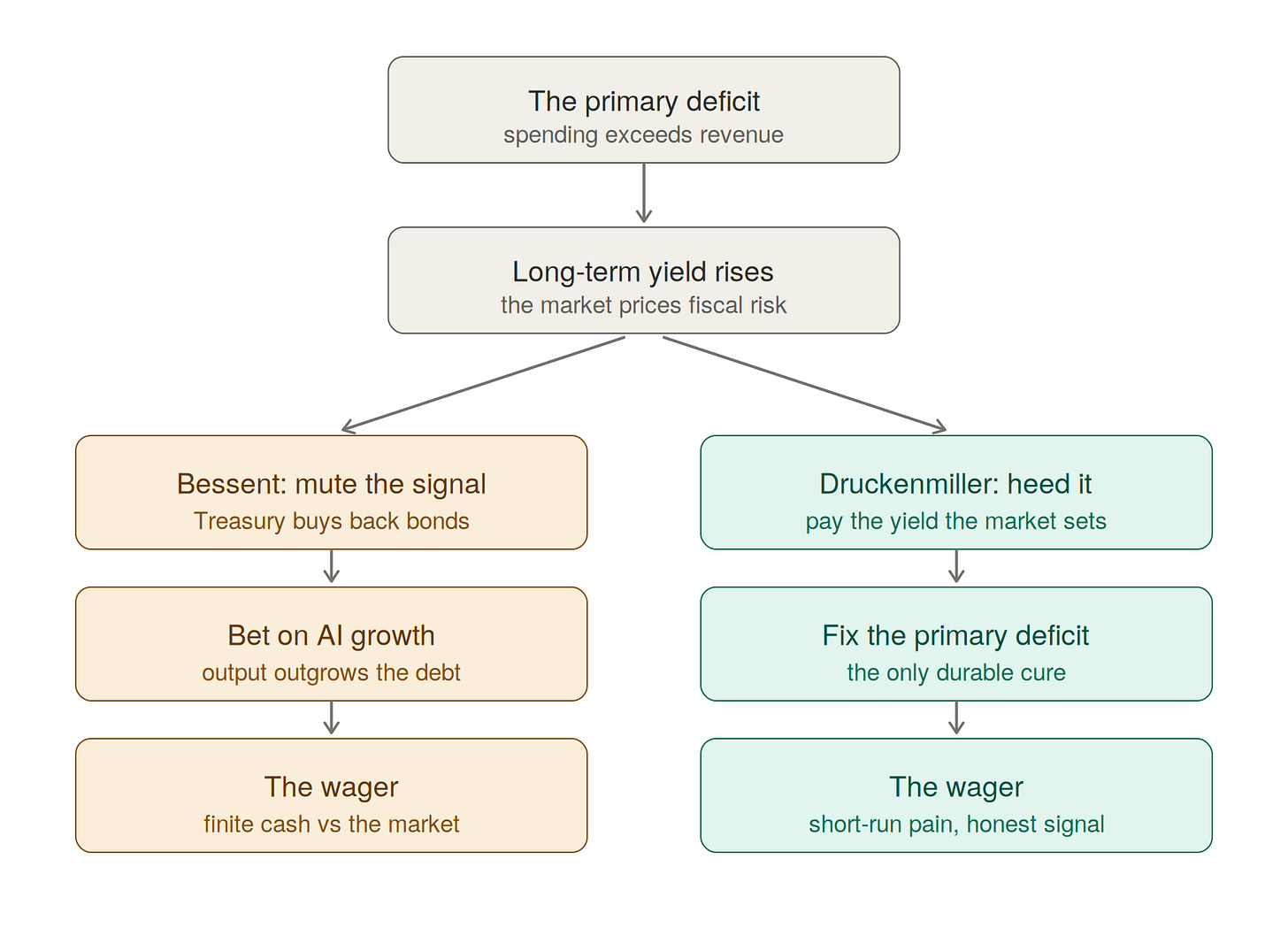
That is the whole complaint in one image. The left side never touches the disease. The right side is the only one that does.
The choice underneath it all
Strip away the jargon and you are left with two honest bets, and neither is free.
Bessent bets the cure arrives before the market calls his bluff. His method is to wait, and to blind himself while waiting.
Druckenmiller bets the country can take the pain of an honest bill now. His method is to leave the alarm on, feel the pressure, and use that pressure to force the only real fix: spend less, and shrink the deficit.
There is no safe option here. There is only a choice about which risk you would rather run, and whether you want the warning light on or off while you run it.
I know which one I would choose. When the stakes are the credibility of the dollar itself, you do not disconnect the smoke detector because you dislike the sound. You find out what is burning.
Growth figures are from the U.S. Bureau of Economic Analysis: real GDP rose at an annual rate of 1.5 percent in the second quarter of 2026 and 2.1 percent in the first, following 0.5 percent in the fourth quarter of 2025.
